


Employees Become Your Strongest Defense Against Cyber Threats in Trust-Based Cultures
I often hear leaders use phrases like culture of safety or people-first leadership. What they usually mean is that if you want a high-performing team, start by making people feel safe to speak up. This fosters creativity, increases efficiency, and elevates employee retention.
If IT teams and business leaders understood that this transcends HR and operations, their risks would decrease drastically. The connection between team psychology and cybersecurity isn’t immediately obvious. Most organizations treat them as separate concerns: HR handles culture, IT handles security. But what if the greatest cybersecurity breakthrough comes from understanding how people actually behave?
”That Would Never Happen to Us”
Many leaders believe their organization is different. They trust their people completely or assume their team is too smart to fall for attacks. This confidence, while admirable, is dangerous.
86% of employees say they could confidently identify phishing emails, while nearly 50% admitted to falling for scams. Even cybersecurity professionals aren’t immune. 98% of cyberattacks rely on social engineering, precisely because these attacks target human psychology rather than technical knowledge.
The statistics reveal an uncomfortable truth. 95% of data breaches involve human error, and just 8% of employees account for 80% of cybersecurity incidents. Your best performers can make mistakes when they’re tired, distracted, or under pressure. 51% of employees admitted to making security mistakes at work when tired, and 50% said they make mistakes when distracted.
The issue isn’t intelligence or competence. Smart, capable people fall victim to sophisticated attacks designed to exploit universal human tendencies like urgency, authority, and trust. Attackers specifically target these psychological triggers because they work regardless of education level or technical expertise.
Organizations that acknowledge this reality and plan accordingly perform better than those that assume immunity. The goal isn’t to eliminate human error but to create environments where mistakes get reported quickly and addressed effectively before the mistake becomes a crisis.
Flipping the script: Hackers use psychology to exploit. We must use it to protect and excel.
The Foundation
Leadership research consistently shows that psychological safety drives performance. When people feel safe to speak up, admit mistakes, and ask questions, teams innovate faster, solve problems more effectively, and make better decisions under pressure. This isn’t just feel-good theory. Organizations with psychologically safe environments measurably outperform those that operate through fear and hierarchy.
The Security Blind Spot
Most cybersecurity programs miss this completely. They focus on technical controls, compliance requirements, and policy enforcement. The human element gets treated as the weakest link rather than the strongest asset.
When security policies are enforced through fear or communicated with technical jargon, employees respond predictably. They comply silently, avoid asking questions, and hide mistakes. This creates exactly what attackers exploit: isolated, uncertain people who won’t speak up when something seems wrong.
Fear Creates Vulnerabilities
Consider what happens when someone accidentally clicks a suspicious link. In a fear-based environment, they stay quiet. They hope nothing happens. They worry about getting in trouble. Meanwhile, that clicked link may have compromised their credentials or installed malware that spreads through the network.
The same pattern repeats across organizations. People download files to personal devices because the approved process seems too complicated to navigate. They use weak passwords because they’re afraid to admit they don’t understand the requirements. They ignore security training because it feels dumb or punitive rather than helpful.
Trust Builds Defense
Organizations that frame security differently get different results. When employees understand that security policies exist to protect their privacy, productivity, and professional success, their behavior shifts fundamentally.
These employees become active participants in security. They report suspicious emails immediately rather than hoping they’re harmless. They ask IT questions before taking actions they’re unsure about. They speak up when they see colleagues taking unnecessary risks.
The technical controls remain the same. The policies stay in place. But the human layer transforms from liability into strength
Implementation Considerations
Building trust-based security requires intentional communication and design. Security policies need clear explanations of why they exist and how they benefit employees. Training should focus on understanding rather than compliance. When mistakes happen, the response should emphasize learning and improvement rather than punishment.
This approach requires balance. Security requirements cannot be compromised, but the experience of meeting those requirements can be supportive rather than adversarial. The goal is to create an environment where following security protocols feels like self-care rather than submission to authority.
Measuring Success
Organizations that successfully implement trust-based security typically see faster incident reporting, higher training engagement, and fewer successful social engineering attacks. Employees become more security-conscious because they understand the value rather than simply fearing the consequences.
The cultural shift takes time, but the security benefits begin immediately. When people feel safe to speak up about security concerns, threats get identified and addressed faster. When they understand why security matters, they become more vigilant and proactive.
The Leadership Opportunity
The most effective cybersecurity strategies recognize that technology alone cannot solve human problems. Security is fundamentally about people making good decisions under pressure. Those decisions improve when people feel supported, informed, and valued rather than monitored, judged, and controlled.
For leaders, this represents both a challenge and an opportunity. Building psychologically safe environments requires consistent effort and genuine commitment to employee wellbeing. But organizations that make this investment often find that their security posture improves alongside their culture.
Your cybersecurity is only as strong as your team’s willingness to engage with it openly. When that engagement comes from trust rather than fear, security and performance improve together.
GET THE FREE GUIDE
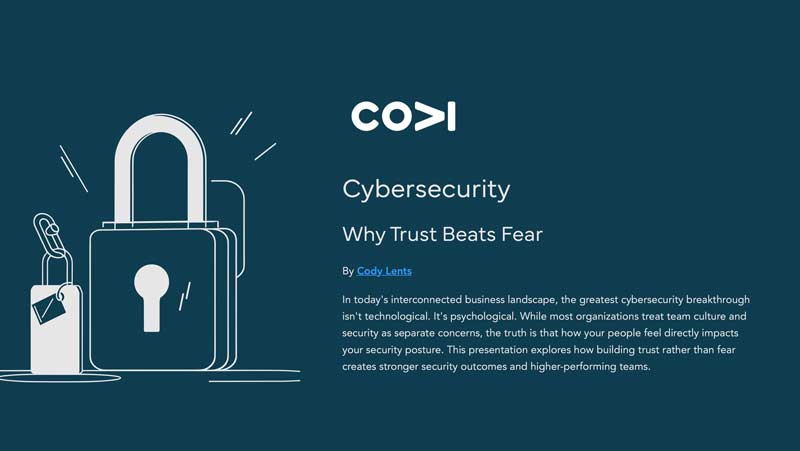
Download our comprehensive presentation “Cybersecurity: Why Trust Beats Fear” to discover the statistics, frameworks, and actionable steps that transform your team from security liability into your strongest defense.. Download Your Free Guide


